Football has a new champion.
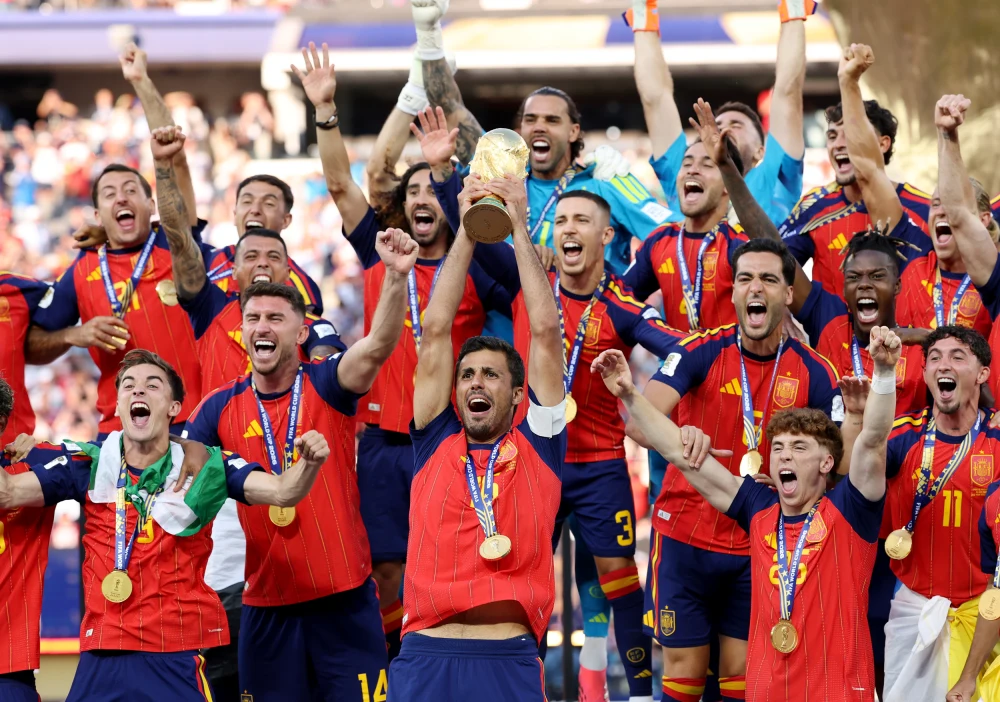
Sixteen years after lifting their first FIFA World Cup trophy in South Africa, Spain once again reached the summit of international football by defeating Argentina 1-0 after extra time in the 2026 FIFA World Cup Final.
The final played at MetLife Stadium was attended by a host of football legends, world leaders, and celebrities. FIFA President Gianni Infantino described the expanded 48-team tournament as “the greatest celebration of football ever staged,” praising the competition’s global reach and record-breaking attendance ahead of kick-off.
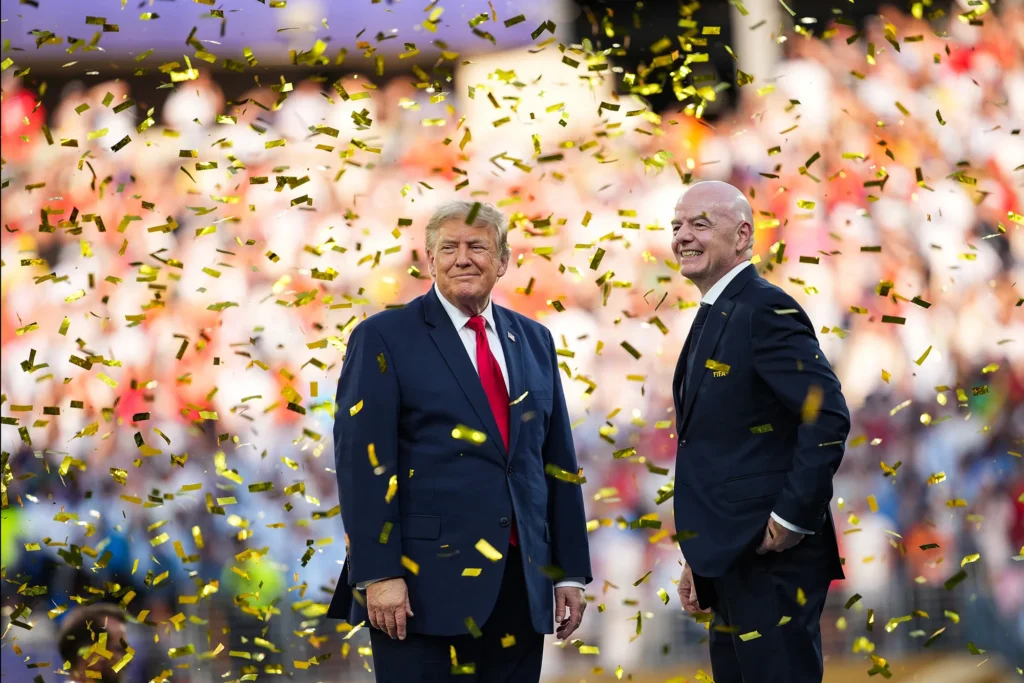
Among the dignitaries in attendance was U.S. President Donald Trump, who watched the final from the VIP section before joining Gianni Infantino during the trophy presentation following Spain’s victory. His appearance attracted significant attention both inside the stadium and across social media throughout the evening.
Played before a packed stadium and millions watching around the globe, the final delivered everything fans expected from two footballing powerhouses – intensity, tactical battles, moments of brilliance, and ultimately, a goal that will forever be remembered in Spanish football history.
Ferran Torres emerged as the hero, scoring the decisive goal in the 106th minute after connecting with Nico Williams’ clever knockdown from Pedro Porro’s cross to crown Spain world champions for the second time. The victory also signaled a new era for Spanish football, proving that the country’s next generation is capable of carrying forward the legacy established by legends such as Xavi, Andrés Iniesta, Sergio Ramos, and Iker Casillas.
For Argentina, the defeat marked a heartbreaking end to another remarkable tournament, as captain Lionel Messi fell just short of retaining the World Cup trophy he famously lifted in Qatar four years earlier. The final could also mark the end of Messi’s extraordinary World Cup journey, adding even greater emotion to the occasion.
Spain’s Journey to the 2026 World Cup Final
Unlike many previous tournaments where favourites stumbled early, Spain steadily grew stronger with every match.
Along the way, La Roja eliminated a series of Europe’s strongest sides, including Kylian Mbappé’s France, before overcoming defending champions Argentina in a dramatic final.
Their blend of youthful flair, technical precision, and tactical discipline made them one of the tournament’s standout teams from the knockout stages onward.
Round of 32: Spain 3-0 Austria
Spain announced themselves as genuine title contenders with a commanding victory over Austria.
Dominating possession from the opening whistle, La Roja suffocated Austria with relentless passing and intelligent movement.
The midfield controlled every phase of play while the attack converted chances with ruthless efficiency.
The convincing victory demonstrated that Spain had rediscovered the fluid attacking football that once made them the benchmark of world football.
Round of 16: Spain 1-0 Portugal
The Iberian Derby lived up to expectations.
Portugal pushed Spain throughout an intense encounter filled with tactical adjustments and physical battles.
With both sides struggling to create clear opportunities, one moment of quality separated the teams.
Spain held firm defensively after taking the lead, frustrating Portugal’s attacking stars and booking a place in the quarter-finals.
It was a mature performance that highlighted Spain’s defensive resilience as much as their attacking quality.
Quarter-final: Spain 2-1 Belgium
Belgium proved to be Spain’s toughest test up to that point.
The match swung from end to end, with both teams creating numerous scoring opportunities.
Spain’s midfield once again became the difference.
Their ability to control possession during crucial moments allowed them to dictate the game’s tempo before finding the decisive breakthrough.
The victory secured Spain’s return to the World Cup semi-finals and reinforced their credentials as one of the tournament favourites.
Semi-final: Spain 2-0 France
Many observers viewed France as the biggest obstacle between Spain and the final.
The reigning European heavyweights possessed incredible attacking talent and tournament experience.
Instead, Spain produced arguably their finest performance of the competition.
Their pressing disrupted France’s build-up play from the opening minutes.
By full time, Spain had earned a deserved 2-0 victory, sending them into their first World Cup final since 2010.
Across Europe, football fans praised the performance as a tactical masterclass.
The 2026 FIFA World Cup Final: Spain 1-0 Argentina (After Extra Time)
Argentina entered the final hoping to retain the trophy they had won four years earlier.
Spain sought redemption, history, and a second World Cup title but standing in their way was Lionel Messi and an experienced Argentina side determined to become back-to-back world champions after their triumph at the 2022 FIFA World Cup.
The contrast in styles made for an intriguing contest.
Argentina relied on their direct attacking transitions and individual brilliance.
Spain trusted their possession-based philosophy, patiently building attacks while maintaining defensive balance.
Neither side wanted to make the first costly mistake.
The opening stages reflected the enormous pressure of the occasion.
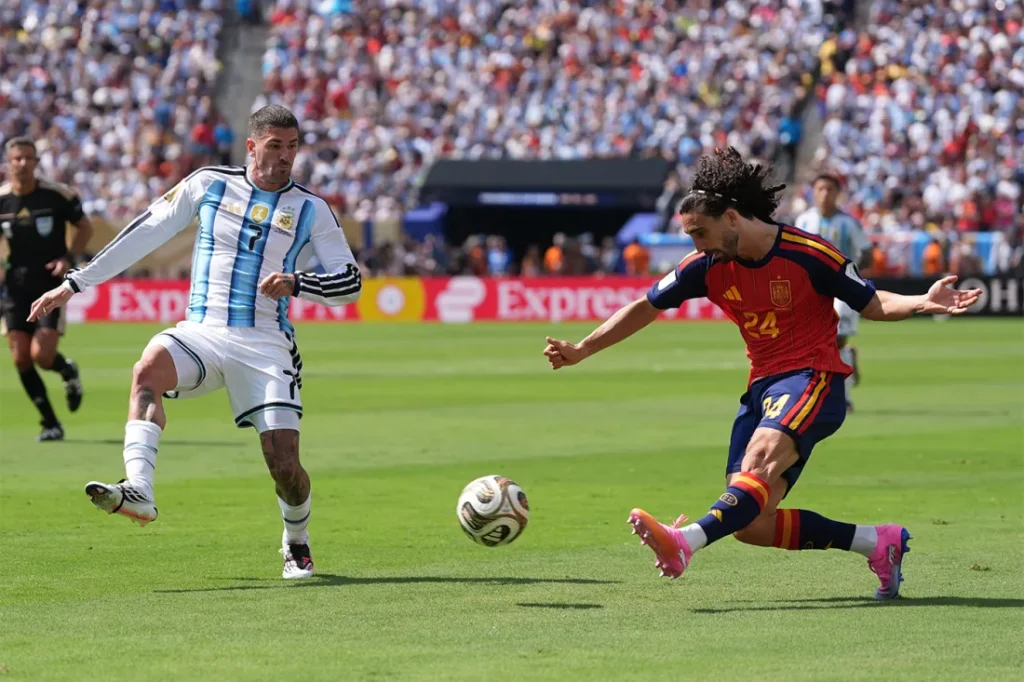
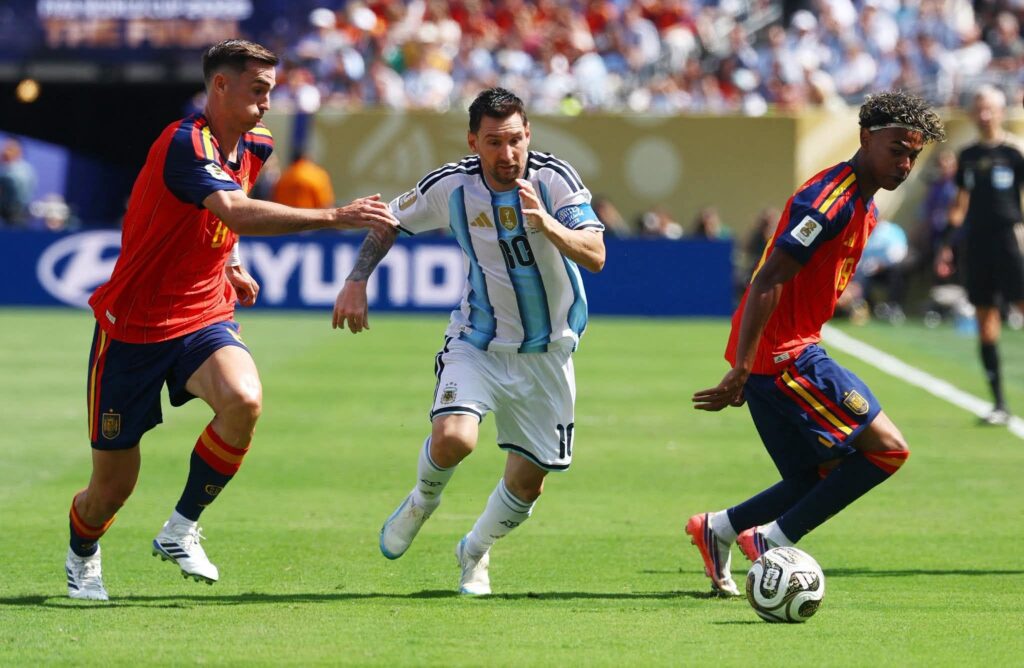
Marc Cucurella (on the right), wearing the number 24 jersey for the Spain national team.
First Half: Tactical Chess
From kickoff, Spain controlled possession without rushing forward.
Argentina defended compactly, with Lionel Messi frequently dropping deep to collect possession before attempting to launch quick attacks alongside Julián Álvarez.
Midfield battles became increasingly intense as every pass, interception, and tackle carried enormous significance.
Rodri marshalled Spain’s defence superbly alongside Eric García, while Marc Cucurella and Pedro Porro remained disciplined on the flanks despite Argentina’s attempts to spring Lionel Messi and Julián Álvarez on the counterattack.
At the opposite end, Argentina goalkeeper Emiliano Martínez delivered one of the greatest goalkeeping performances in World Cup final history, producing save after save to frustrate Spain’s attackers. Martínez ultimately finished with 11 saves, a new record for a goalkeeper in a FIFA World Cup final but could do nothing to prevent Ferran Torres’ win.
The match developed into a fascinating tactical contest rather than an open attacking spectacle.
When the halftime whistle arrived, neither side had found the breakthrough.
Second Half: Chances at Both Ends
The tempo increased immediately after the restart.
Spain began pressing higher up the pitch, forcing Argentina into mistakes during build-up play.
Messi orchestrated several dangerous attacks after the restart, combining well with Julián Álvarez and Enzo Fernández as Argentina searched for the breakthrough. However, Spain’s disciplined defensive structure continued to frustrate the reigning champions.
Both goalkeepers produced crucial saves to keep the score level. Emiliano Martínez continued to frustrate Spain with a string of outstanding saves, while Spain goalkeeper Unai Simón remained alert whenever Argentina threatened, comfortably dealing with the few clear openings created by Lionel Messi and his teammates.
As fatigue began affecting players, managers introduced fresh legs from the bench.
Each substitution altered the tactical dynamics, creating fresh attacking possibilities.
Despite numerous opportunities, the deadlock remained intact after ninety minutes.
For the second consecutive World Cup final involving Spain, extra time would decide the champions.
Argentina Reduced to Ten Men
The momentum of the final shifted dramatically in the opening moments of extra time.
Argentina midfielder Enzo Fernández was sent off after receiving a second yellow card following a reckless challenge, leaving Lionel Scaloni’s side to play the remainder of the final with ten men. The dismissal forced Argentina to abandon their cautious approach and defend with a numerical disadvantage against Spain’s relentless possession game.
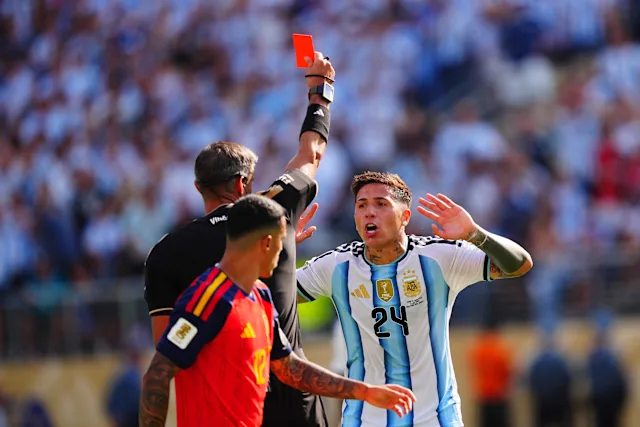
Extra Time Delivers a Hero
With penalties appearing increasingly likely, Spain found the decisive breakthrough.
A patient Spanish move finally broke Argentina’s resistance. Pedro Porro whipped an inviting cross into the penalty area where Nico Williams intelligently headed the ball into the path of substitute Ferran Torres, who calmly swept a left-footed finish beyond Emiliano Martínez in the 106th minute.
Remaining remarkably calm under immense pressure, Torres produced a composed finish beyond the goalkeeper.
The stadium erupted.
As Spanish players celebrated, television cameras captured a visibly disappointed Lionel Messi standing near the centre circle, knowing Argentina now had only minutes to keep their title hopes alive.
The goal proved decisive.
Spain defended with remarkable discipline during the closing stages, refusing to surrender their narrow advantage. Rodri and Eric García led a composed defensive effort during the closing stages, while Unai Simón remained assured whenever Argentina launched desperate attacks in search of an equaliser.
When the referee blew the final whistle, years of preparation, belief, and determination culminated in football’s greatest prize.
Spain were world champions once again.
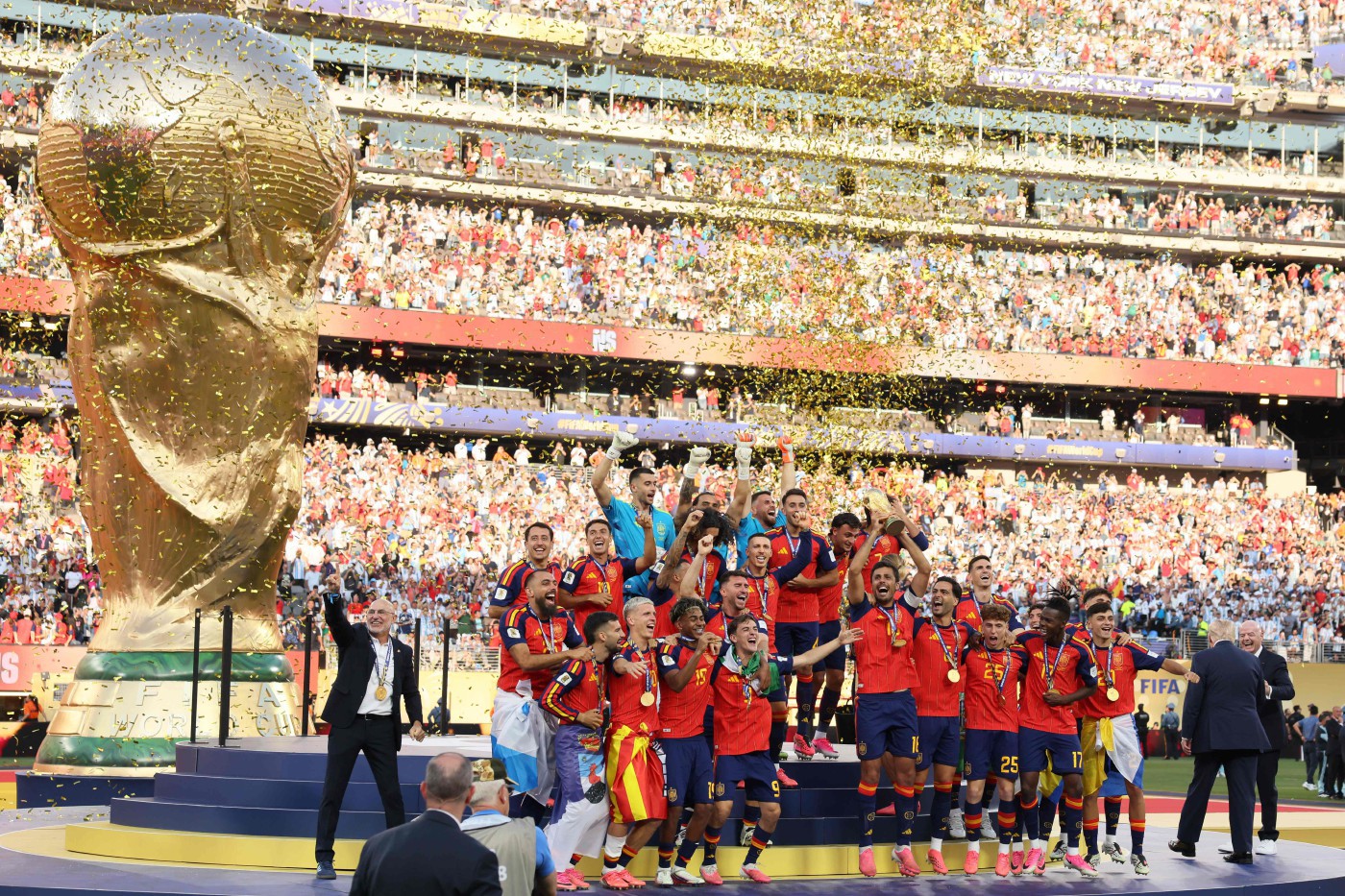
Moments later, Spain captain Rodri lifted the FIFA World Cup trophy alongside FIFA President Gianni Infantino and U.S. President Donald Trump, officially bringing the curtain down on one of the most memorable tournaments in modern football. The trophy presentation itself generated widespread discussion online as millions watched Spain celebrate their historic triumph.
Tensions spilled over after the final whistle as emotions boiled over between players from both sides. Argentina’s Leandro Paredes became involved in an altercation with Spain’s Eric García and Gavi, prompting FIFA to open an investigation into the post-match incident.